> For the complete documentation index, see [llms.txt](https://docs.neuroinfodb.org/squirrel/llms.txt). Markdown versions of documentation pages are available by appending `.md` to page URLs; this page is available as [Markdown](https://docs.neuroinfodb.org/squirrel/squirrel-data-sharing-format.md).
# Squirrel data sharing format
## Overview
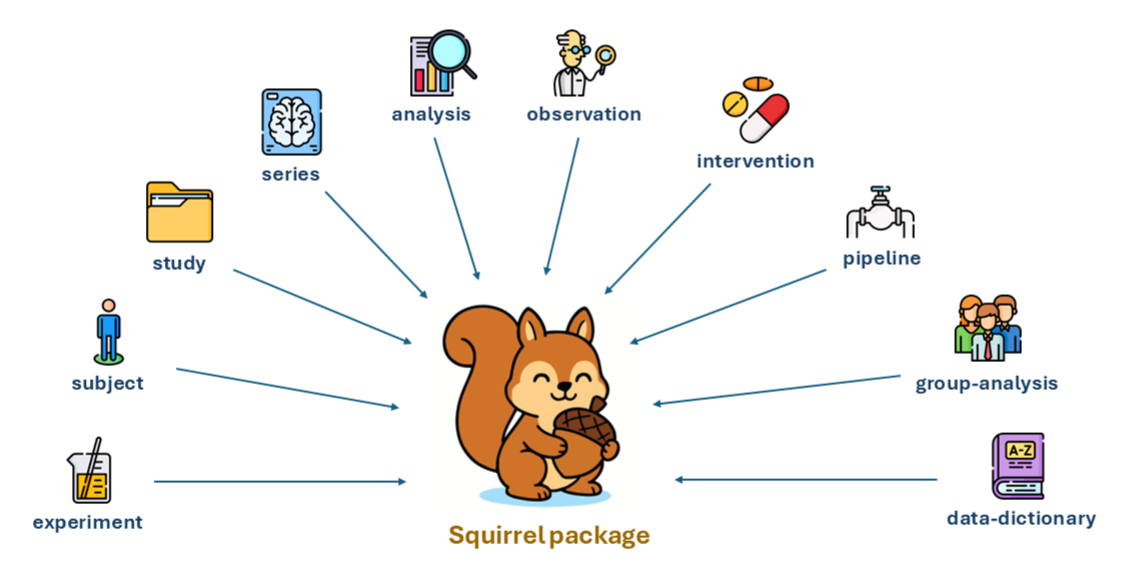
The squirrel data sharing format is designed to allow easy sharing of neuroimaging data. All research imaging data can be categorized into one of 10 object types. Squirrel organizes these objects into a heirarchy, allowing sharing of complex datasets that span raw data (and experiments used to collect it) to analyzed data (and the methods used to analyze), and everything in between.
Cute and corny, but an accurate description of the squirrel format
## Get squirrel
Squirrel utilities are available from our github repository:
Package installers are available for
* RHEL 8 and compatible
* RHEL 9 and compatible
* RHEL 10 and compatible
* debian 12
* Ubuntu 24
Source code is avilable to build squirrel utilities or library.
### Squirrel object types
All neuroimaging data can be categorized into one of these 10 object types
| Object | Description | Example |
| ------------------- | ---------------------------------------------------------------------------------------------------------- | --------------------------------------------------- |
| **analysis** | Analysis results | freesurfer analysis results |
| **data-dictionary** | Data dictionary with key-value pairs to describe variables | Female=1, Male=2... |
| **experiment** | An experiment used to collect raw data. Can include task instructions, or behavioral data analysis scripts | A go-no-go task; with ePrime files |
| **group-analysis** | Contains all data related to a group analysis | |
| **intervention** | Data about something administered to the subject | Drug dosing information |
| **observation** | Data about something observed from the subject | PANS, SCID, etc |
| **pipeline** | Analysis pipeline script; with extra script or other files necessary to perform the analysis. | A script to run an FSL analysis |
| **series** | Unique imaging series. A study can have more than one imaging series. | T1w from an MRI |
| **study** | Unique imaging session. A subject can have more than one study | A set of MRI images collected during a scan session |
| **subject** | Unique subject | A human, monkey, bacteria, etc |
## Contribute
Squirrel format is open-source and we are always looking for contributions.
## Publications
* Book GA, Calhoun VD, Stevens MC, Pearlson GD. *Sharing Neuroimaging Data with Squirrel - A Relational Data Format to Store Raw to Analyzed Data and Everything in Between.* Neuroinformatics. 2025 Jul 3;23(3):37. doi: 10.1007/s12021-025-09732-7. PMID: 40610663.
---
# Agent Instructions
This documentation is published with GitBook. GitBook is the documentation platform designed so that both humans and AI agents can read, navigate, and reason over technical content effectively. Learn more at gitbook.com.
## Querying This Documentation
If you need additional information that is not directly available in this page, you can query the documentation by asking a question.
Perform an HTTP GET request on the following URL with the `ask` and `goal` query parameters:
```
GET https://docs.neuroinfodb.org/squirrel/squirrel-data-sharing-format.md?ask=&goal=
```
`ask` is the immediate question: it should be specific, self-contained, and written in natural language.
`goal` is what the user is ultimately trying to achieve, the reason they need the answer. Sharing it helps GitBook give you a better, more relevant answer. A goal is most helpful when it describes the outcome the user wants rather than restating the question. For example, with `ask=how do I create an API token`, a goal like `automate deployments from our CI pipeline` lets GitBook tailor the answer to that use case.
The response will contain a direct answer to the question and relevant excerpts and sources from the documentation.
Use this mechanism when the answer is not explicitly present in the current page, you need clarification or additional context, or you want to retrieve related documentation sections.