> For the complete documentation index, see [llms.txt](https://docs.neuroinfodb.org/squirrel/llms.txt). Markdown versions of documentation pages are available by appending `.md` to page URLs; this page is available as [Markdown](https://docs.neuroinfodb.org/squirrel/specifications/specification-v1.0/data/subjects.md). Agents can also search and read this documentation through its [MCP server](https://docs.neuroinfodb.org/squirrel/~gitbook/mcp).

# subjects

JSON array

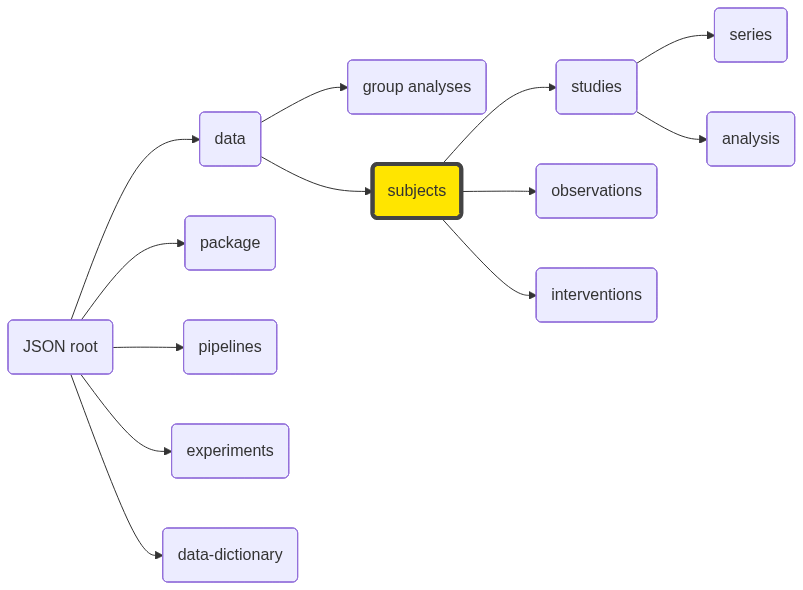
This object is an **array** of subjects, with information about each subject.

<figure><img src="https://mermaid.ink/img/pako:eNqVlEFvgjAUx78KqTGBBBazuAtLPG2XZdmSeVu4POlDOoGStmwS43dfSykKelAO9P3b37-vfU85kJRTJDHZCqhz7_0rqTz9CM6V_7b-_OiiIIpWFBT45hU8nxA9X0O6gy36_ThdZTUWrELpD9GEwH2NgpVYKemfxRPKJI4oSxXjFYjWn-jAwt1stNoK3tRQQdFKnbhTnpNu3x6VzeYHU53aBW7dacOohjK9UT9eIfhGovgFcxjpn4srLKuUXtZX7OCRGmibyKTW5TCZu-Fy2V6KSd8FDpnPrSV6MA0SUMqMFaZHJnTQJWqKYkA5avR8ftYXg52khU_a6yYC5xt63p2jF9bj1MThLmIMLrYGp0aG4QqqLdAbjm-YIp5lWRbqagm-w4iCzEEIaOPHsWmU5R7jpAr3WEeluMU4sQ8dvcVrPe4XODjwabEIrSeeLZfLPo7-GFV5vKz3JCQlihIY1V-Hg9krISrHEhMS65BiBk2hEpJUR402ta4-vlKmuCBxBoXEkECj-LqtUhIr0aCDXhjoj005UPqv-s2508d_DN-SVw?type=png" alt=""><figcaption></figcaption></figure>

### JSON variables

:blue\_circle: Primary key\
:red\_circle: Required\
:yellow\_circle: Computed (squirrel writer/reader should handle these variables)

<table data-full-width="true"><thead><tr><th width="224" align="right">Variable</th><th width="152">Type</th><th width="95">Default</th><th>Description (and possible values)</th></tr></thead><tbody><tr><td align="right"><code>AlternateIDs</code></td><td>JSON array</td><td></td><td>List of alternate IDs.</td></tr><tr><td align="right"><code>DateOfBirth</code></td><td>date</td><td><span data-gb-custom-inline data-tag="emoji" data-code="1f534">🔴</span></td><td>Subject’s date of birth. Used to calculate age-at-study. Value can be <code>YYYY-00-00</code> to store year only, or <code>YYYY-MM-00</code> to store year and month only.</td></tr><tr><td align="right"><code>EnrollmentGroup</code></td><td>string</td><td></td><td>Enrollment group. Example: patient, control, etc.</td></tr><tr><td align="right"><code>EnrollmentStatus</code></td><td>string</td><td></td><td>Project enrollment status: excluded, completed, etc.</td></tr><tr><td align="right"><code>Ethnicity1</code></td><td>string</td><td></td><td>NIH defined ethnicity: Usually <code>hispanic</code>, <code>non-hispanic</code></td></tr><tr><td align="right"><code>Ethnicity2</code></td><td>string</td><td></td><td>NIH defined race: <code>americanindian</code>, <code>asian</code>, <code>black</code>, <code>hispanic</code>, <code>islander</code>, <code>white</code></td></tr><tr><td align="right"><code>Gender</code></td><td>char</td><td></td><td>Gender.</td></tr><tr><td align="right"><code>GUID</code></td><td>string</td><td></td><td>Globally unique identifier, from the NIMH Data Archive (<a href="https://nda.nih.gov/">NDA</a>).</td></tr><tr><td align="right"><code>Notes</code></td><td>string</td><td></td><td>Notes about this subject.</td></tr><tr><td align="right"><code>Sex</code></td><td>char</td><td><span data-gb-custom-inline data-tag="emoji" data-code="1f534">🔴</span></td><td>Sex at birth (F,M,O,U).</td></tr><tr><td align="right"><code>SubjectID</code></td><td>string</td><td><span data-gb-custom-inline data-tag="emoji" data-code="1f534">🔴</span> <span data-gb-custom-inline data-tag="emoji" data-code="1f535">🔵</span></td><td>Unique ID of this subject. Each subject ID must be unique within the package.</td></tr><tr><td align="right"><code>InterventionCount</code></td><td>number</td><td><span data-gb-custom-inline data-tag="emoji" data-code="1f7e1">🟡</span></td><td>Number of intervention objects. Only written if the subject has interventions.</td></tr><tr><td align="right"><code>ObservationCount</code></td><td>number</td><td><span data-gb-custom-inline data-tag="emoji" data-code="1f7e1">🟡</span></td><td>Number of observation objects. Only written if the subject has observations.</td></tr><tr><td align="right"><code>StudyCount</code></td><td>number</td><td><span data-gb-custom-inline data-tag="emoji" data-code="1f7e1">🟡</span></td><td>Number of studies. Only written if the subject has studies.</td></tr><tr><td align="right"><code>VirtualPath</code></td><td>string</td><td><span data-gb-custom-inline data-tag="emoji" data-code="1f7e1">🟡</span></td><td>Relative path to the data within the package.</td></tr><tr><td align="right"><a href="https://docs.neuroinfodb.org/squirrel/specifications/specification-v1.0/data/subjects/studies.md">studies</a></td><td>JSON array</td><td></td><td>Array of imaging studies/sessions.</td></tr><tr><td align="right"><a href="https://docs.neuroinfodb.org/squirrel/specifications/specification-v1.0/data/subjects/observations.md">observations</a></td><td>JSON array</td><td></td><td>Array of observations.</td></tr><tr><td align="right"><a href="https://docs.neuroinfodb.org/squirrel/specifications/specification-v1.0/data/subjects/interventions.md">interventions</a></td><td>JSON array</td><td></td><td>Array of interventions.</td></tr></tbody></table>

### Directory structure

Files associated with this section are stored in the following directory. If `SubjectDirectoryFormat` is `seq`, a sequential number is used instead of the subject ID.

> `/data/<SubjectID>`


---

# Agent Instructions
This documentation is published with GitBook. GitBook is the documentation platform designed so that both humans and AI agents can read, navigate, and reason over technical content effectively. Learn more at gitbook.com.

## Querying This Documentation
If you need additional information that is not directly available in this page, you can query the documentation by asking a question.

Perform an HTTP GET request on the following URL with the `ask` and `goal` query parameters:

```
GET https://docs.neuroinfodb.org/squirrel/specifications/specification-v1.0/data/subjects.md?ask=<question>&goal=<user_goal>
```

`ask` is the immediate question: it should be specific, self-contained, and written in natural language.
`goal` is what the user is ultimately trying to achieve, the reason they need the answer. Sharing it helps GitBook give you a better, more relevant answer. A goal is most helpful when it describes the outcome the user wants rather than restating the question. For example, with `ask=how do I create an API token`, a goal like `automate deployments from our CI pipeline` lets GitBook tailor the answer to that use case.

The response will contain a direct answer to the question and relevant excerpts and sources from the documentation.

Use this mechanism when the answer is not explicitly present in the current page, you need clarification or additional context, or you want to retrieve related documentation sections.